Blackburn’s position in the Ribble Valley means the town sits on a mix of glacial till, alluvial clays and interbedded mudstones that produce markedly different soil behaviours within a single site. The clay-rich deposits, when exposed to the region’s 1,200 mm average annual rainfall, can shift from a stiff consistency in summer to a soft, sticky mass in winter. That seasonal moisture swing makes the Atterberg limits — liquid limit, plastic limit and shrinkage limit — essential for predicting how these soils will behave under strip footings or reinforced concrete slabs. Before any foundation design begins, we run the full Atterberg suite to classify plasticity, and we often pair it with a granulometríaanalysis to understand the full particle-size distribution and how fines content affects volume change.
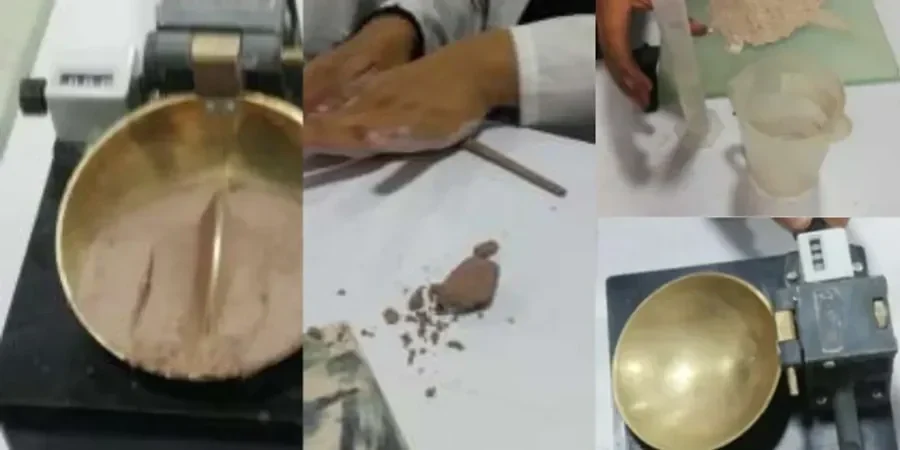
A plasticity index jump from 20 % to 40 % can double the swelling pressure under a slab in Blackburn’s clay-rich glacial till.
Technical details of the service in Blackburn
Risks and considerations in Blackburn
Blackburn sits at roughly 150 m above sea level on the western edge of the Pennines, where the bedrock is Carboniferous Millstone Grit overlain by up to 8 m of glacial till. That till contains highly plastic clay matrices that, when wetted beyond the plastic limit, lose shear strength rapidly. If the Atterberg limits are not measured early, the design might assume a stiff clay with a safe bearing capacity of 150 kN/m² when the actual plasticity index places it in the high-swell category. After a wet winter, the same clay can develop desiccation cracks, and the next rainfall event forces water into those cracks, triggering cyclic volume changes that crack ground-floor slabs and lift partition walls.
Our services
Our Blackburn geotechnical laboratory delivers a full range of index and classification testing services, all performed under UKAS-accredited procedures. Every Atterberg limit test is completed within five working days, with a detailed report that includes the plasticity chart, activity ratio, and correlation with expected volume change potential.
Liquid & Plastic Limit Determination
We measure the liquid limit using the BS cone penetrometer (80 g, 30° cone) and the plastic limit by rolling 3 mm threads. Results are plotted on the Casagrande plasticity chart to classify the soil as low, medium, high or very high plasticity. Typical turnaround is three days for a full set of limits.
Shrinkage Limit & Linear Shrinkage
For clays that will be used as fill or exposed to seasonal moisture changes, we determine the shrinkage limit and linear shrinkage ratio. This is critical for projects in Blackburn’s residential developments where clay heave can damage shallow foundations and driveways.
Plasticity Index & Activity Ratio
We compute the plasticity index (PI = LL – PL) and the activity ratio (PI / percentage of clay-size fraction) to predict swelling potential. A PI above 35 % in Blackburn’s glacial till indicates high shrinkage-swelling behaviour that requires deeper foundations or Improvement.
Questions and answers
What is the purpose of Atterberg limits in geotechnical engineering?
Atterberg limits define the moisture content thresholds at which a cohesive soil changes from a solid to a semi-solid (shrinkage limit), semi-solid to plastic (plastic limit), and plastic to liquid (liquid limit). They are the primary index tests for classifying fine-grained soils and predicting volume change, shear strength and compressibility.
How much does Atterberg limits testing cost in Blackburn?
The typical cost for a full set of Atterberg limits (liquid limit, plastic limit, plasticity index and shrinkage limit) ranges from £40 to £80 per sample, depending on the number of limits required and whether linear shrinkage is included. Bulk-site discounts apply for multiple samples.
How are Atterberg limits used to classify clay soils in Blackburn?
The liquid limit and plasticity index are plotted on the Casagrande plasticity chart to assign a classification such as low plasticity (CL), high plasticity (CH) or very high plasticity (CV/E). In Blackburn’s glacial till, CH and CV clays are common, and they require special foundation detailing to accommodate swelling.
What sample condition is required for Atterberg limits testing?
We require a minimum of 500 g of cohesive material passing the 425 µm sieve, preferably from undisturbed or bag samples taken at representative depths. The soil must be kept at its natural moisture content; air-dried or oven-dried samples are not suitable because drying alters the clay’s plasticity.
Can Atterberg limits predict swelling potential reliably?
Yes, when combined with the clay fraction and the activity ratio, the plasticity index gives a reliable first-order estimate of swelling potential. For Blackburn’s high-PI clays, a PI above 35 % usually correlates with medium to high swell, but we always recommend a free-swell oedometer test for critical structures.