A common mistake made by contractors working across Blackburn’s varied geology is assuming that one soil profile fits the whole borough. The clay-rich glacial till found beneath the town centre behaves very differently from the alluvial deposits near the River Blakewater, and treating them the same during foundation design can lead to uneven settlement within the first few years. Without a proper settlement analysis, structures risk differential movement that cracks cladding, distorts floor slabs and eventually compromises the building’s stability. That is why we combine consolidation testing with on-site monitoring and a thorough estudio de mecánica de suelos to capture the true compressibility of each stratum before any load is applied.
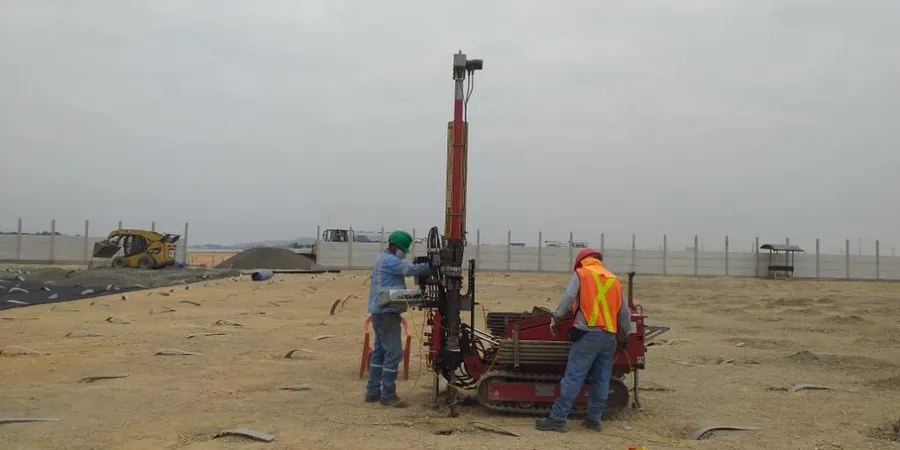
For Blackburn’s glacial clays and alluvial pockets, measured compression indices typically range from 0.12 to 0.29, making site-specific consolidation testing essential for safe foundation design.
Technical details of the service in Blackburn
- One-dimensional oedometer tests to determine compression index and pre-consolidation pressure.
- Calculation of immediate, primary and secondary settlement using the consolidation characteristics of the critical layer.
- Finite-element modelling for differential settlement on raft or strip footings.
Procedure video
Risks and considerations in Blackburn
Blackburn sits at approximately 130 metres above sea level in its centre, but the elevation drops sharply toward the valley floors, where the River Blakewater and its tributaries have deposited soft alluvial silts and peat over the last several thousand years. These low-lying zones are particularly susceptible to long-term consolidation settlement when loaded by new construction. Ignoring the pre-consolidation history of these soft layers can lead to differential movements exceeding 50 mm within a decade, damaging brickwork and service connections. A focused settlement analysis identifies these risk zones early, allowing the design team to specify Improvement or deeper foundations before any concrete is poured.
Our services
Our settlement analysis service in Blackburn covers the full workflow from soil sampling to numerical modelling, ensuring each project receives the level of detail its ground conditions demand.
Consolidation Testing (Oedometer)
Multi-stage incremental loading tests on undisturbed samples to determine compression index, pre-consolidation pressure and coefficient of consolidation for each soil layer.
Settlement Calculation & Modelling
Analytical and finite-element calculation of immediate, primary and secondary settlement under serviceability loads, including differential settlement between adjacent footings.
Peat & Organic Soil Assessment
Specialised evaluation of secondary compression ratio and creep potential in Blackburn’s alluvial organic layers, critical for long-term performance of embankments and shallow foundations.
Improvement Verification
Post-treatment settlement monitoring via plate load tests and settlement gauges to confirm that preloading, vibro-compaction or stone columns have achieved the design target.
Questions and answers
What is the difference between immediate, primary and secondary settlement?
Immediate settlement occurs almost instantly as soil deforms elastically under load. Primary settlement is the gradual volume change caused by dissipation of excess pore water pressure in saturated clays — it can take months or years. Secondary settlement is the continued creep of the soil skeleton under constant effective stress, especially significant in peat and organic soils.
How much does a settlement analysis cost for a typical residential project in Blackburn?
For a standard two-storey dwelling on clay, the combined sampling, oedometer testing and reporting typically ranges between £500 and £1,130, depending on the number of boreholes and soil layers tested. Larger commercial projects with finite-element modelling sit at the upper end and require a tailored quote.
Which soil types in Blackburn pose the highest settlement risk?
The soft alluvial clays and peat lenses found in the valley bottoms of Audley and Little Harwood present the highest risk, with compression indices often above 0.20. Glacial till on the higher ground is generally stiffer but can still undergo significant consolidation if the till is weathered or contains silt partings.
Can settlement analysis be performed on existing structures showing cracks?
Yes. We can install settlement gauges and inclinometers on the affected building, correlate crack patterns with ground movement data, and back-analyse the soil parameters using the observed displacement. This helps determine whether the movement has stabilised or requires remedial intervention such as underpinning.
What Eurocode 7 partial factors apply to settlement calculations?
Under BS EN 1997-1, serviceability limit state (SLS) calculations for settlement typically use partial factors of 1.0 on actions and material properties. The design settlement must not exceed the limiting values specified in the National Annex (commonly 25 mm total and 10 mm differential for masonry structures).