Blackburn sits on a complex mix of glacial till, alluvial deposits, and made ground from its industrial past, which means standard boreholes often miss critical variability. Eurocode 7 (EN 1997-2:2007) and BS 5930:2015 both recommend the cone penetration test as a primary method for continuous stratigraphic profiling, and here it is especially valuable for distinguishing between competent till and softer lenses of sand or silt. We deploy a 20-tonne truck-mounted rig with an electric piezocone that records tip resistance, sleeve friction, and pore pressure every 2 cm, giving you a near-continuous log from the surface down to refusal. Before we mobilise, we cross-reference historical maps from the British Geological Survey to identify old mine shafts or infilled mill ponds that could affect cone refusal depth.
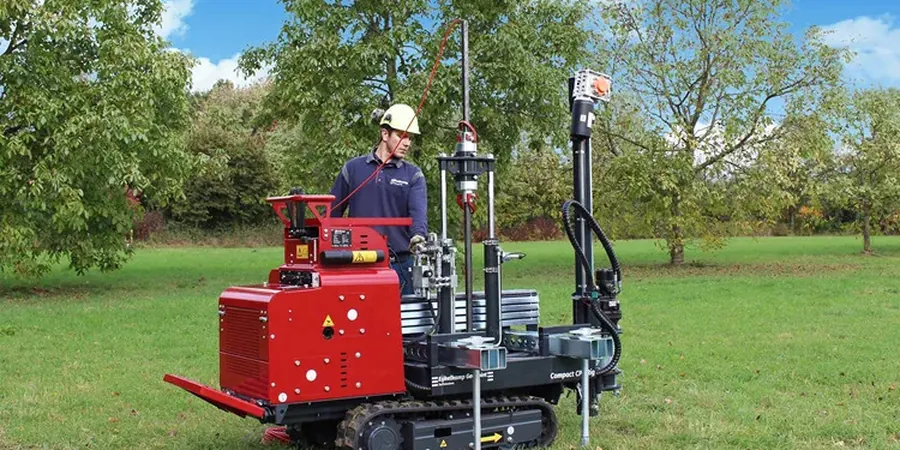
Continuous CPT profiling in Blackburn’s glacial till reveals interbedded sand lenses that standard SPT boreholes routinely miss, reducing foundation risk by up to 30%.
Technical details of the service in Blackburn
Procedure video
Risks and considerations in Blackburn
The steep-sided valleys around Blackburn, combined with high groundwater from the Pennine rainfall, create a real risk of slope instability when developments cut into the hillside. A CPT profile can detect thin silt seams within the till that act as slip planes under saturated conditions — something a standard borehole would miss entirely. On a recent retail park extension near the M65, we used CPT data to identify a 0.3 m soft silt layer at 6 m depth that reduced the factor of safety for a proposed retaining wall from 1.5 to 1.1. That insight saved the client from a costly failure and led to a redesign with a drainage blanket and soil nails. Ignoring these subtle layers in Blackburn’s geology can turn a routine excavation into an emergency stabilisation project.
Our services
We offer two specialised CPT service levels tailored to Blackburn’s ground conditions and project budgets.
Standard CPT with Pore Pressure (CPTu)
Full electric piezocone sounding with real-time data acquisition, interpreted to Robertson (1990) soil behaviour type, including undrained shear strength for clays and friction angle for sands. Suitable for residential foundations, road embankments, and small commercial plots. Includes a factual report with depth plots and summary table.
Advanced CPT with Seismic Module (SCPTu)
Adds a downhole seismic source to measure vs30/" data-interlink="1">shear wave velocity (Vs) at 1 m intervals, allowing dynamic soil characterisation for earthquake design (Eurocode 8 site class) and vibration-sensitive projects. Ideal for Blackburn sites near railways or future HS2 alignments. Includes Vs profile and site classification.
Questions and answers
How much does a CPT test cost in Blackburn?
For a standard electric piezocone sounding to 15 m depth, you can expect a range of £140 to £190 per test, including mobilisation within the Blackburn postcode area. Costs vary with depth, number of soundings, and site access conditions — multiple soundings on the same site reduce the per-test rate.
What is the difference between CPT and SPT?
The CPT provides a continuous profile of tip resistance, sleeve friction, and pore pressure every 2 cm, while the SPT gives discrete blow counts every metre. In Blackburn’s glacial till, the CPT is better at detecting thin sand or silt seams that affect drainage and shear strength. The SPT remains useful for gravel-rich layers where the cone might refuse early.
How deep can the CPT penetrate in Blackburn’s ground?
Typical depth is 10–15 m, limited by dense glacial till or gravel layers that can exceed the cone’s 25 MPa tip capacity. In softer alluvial deposits near the River Darwen, we have reached 20 m. We always review historical borehole logs from the BGS database before mobilising to estimate refusal depth.
Do you need a CPT for a single house extension in Blackburn?
For a simple extension on shallow strip footings, a desk study and trial pit may suffice. However, if the property is on a sloping site or near old mine workings, a single CPT sounding to 6–8 m provides a cost-effective way to rule out soft layers or groundwater issues that could cause differential settlement. It often costs less than a structural repair later.
How long does it take to get CPT results in Blackburn?
On-site testing takes one to two hours per sounding. A factual report with raw data plots and interpreted soil behaviour type is typically delivered within five working days. If a full geotechnical interpretative report with foundation recommendations is needed, allow ten working days.