For deep basement and shaft excavations in Blackburn, diaphragm wall design must follow Eurocode 7 (EN 1997-1:2004) alongside BS EN 1538 for execution. What makes Blackburn particularly challenging is the variable glacial till sequence overlying Millstone Grit and Lower Coal Measures. We have seen boreholes in the town centre where stiff lodgement till changes abruptly to sand and gravel lenses within a few metres. A proper diaphragm wall solution here demands a detailed ground model that accounts for these lateral variations. Before we finalise wall embedment and panel layout, we often recommend a complementary [MASW survey](/masw-vs30/) to map stiffness contrasts across the site, and a trial pit programme to validate the continuity of cohesive layers. Our team designs walls for temporary and permanent conditions, always integrating structural and geotechnical checks.
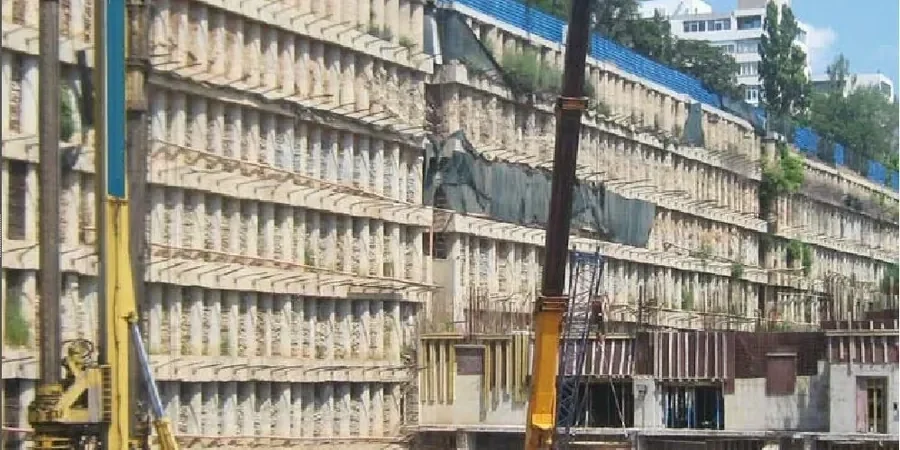
In Blackburn, diaphragm wall embedment must consider both glacial till bearing capacity and underlying Coal Measures rockhead variability within the same site.
Technical details of the service in Blackburn
- Undrained shear strength of till (typically 100–250 kPa from triaxial and vane tests)
- Friction angle of granular lenses (32–38 degrees)
- Mass permeability of the till sequence (often 1e-9 to 1e-7 m/s)
- Rock quality designation (RQD) for the sandstone horizon
Risks and considerations in Blackburn
One of the biggest risks we see in Blackburn diaphragm wall design is the presence of old mining workings within the Coal Measures. Between the town centre and the M65 corridor, shallow coal seams have been worked historically, and if a panel intercepts a void or backfilled workings, slurry loss can be catastrophic. We compare the eastern side of Blackburn, where till is thicker and more consistent, with the western suburbs where rockhead is shallower and old shafts are more frequent. A thorough desk study and exploratory boreholes are essential before committing to a wall alignment.
Our services
Our diaphragm wall design service for Blackburn covers every stage from feasibility to construction support.
Feasibility and ground model development
We compile existing borehole data from Blackburn's geological records and commission targeted site investigations to characterise till thickness, rockhead level, and groundwater regime before wall design begins.
Structural and geotechnical wall design
Using finite element software (Plaxis 2D/3D), we calculate bending moments, shear forces, and deflections for each panel, applying partial factors from Eurocode 7 for both ULS and SLS conditions.
Construction support and monitoring
During excavation, our engineers review slurry parameters, concrete records, and inclinometer data to verify that the as-built wall matches design assumptions, adjusting panel layout if ground conditions differ.
Questions and answers
What is the typical cost range for diaphragm wall design in Blackburn?
For a medium-depth basement wall (8 to 12 metres deep, up to 30 panels), the design fee including ground model development and structural calculations typically falls between £1,330 and £5,600. This depends on site complexity, number of load cases, and whether temporary or permanent conditions are required.
What ground conditions most affect diaphragm wall design in Blackburn?
The glacial till sequence and underlying Coal Measures rockhead are the main variables. Where till is stiff and uniform, wall embedment can be optimised; where old mine workings or sand channels are present, deeper panels or additional stabilisation may be needed. A good desk study can reduce this uncertainty.
Do you design for temporary or permanent diaphragm walls?
We design for both. Temporary walls are checked for stability during construction with a factor of safety of 1.2 against trench collapse. Permanent walls also require durability checks, cover to reinforcement per BS EN 1992, and groundwater ingress limits. Both follow Eurocode 7 partial factors.
How long does the diaphragm wall design process take for a typical Blackburn project?
For a straightforward basement with 20–30 panels and good ground data, the design can be completed in 3 to 4 weeks. If additional site investigation or mining risk assessment is required, add 2 to 3 weeks. We coordinate with the contractor's programme to avoid delays.