A recent retail unit extension on the M65 corridor in Blackburn cracked its load-bearing blockwork within six months of completion. The culprit was differential settlement between the original strip footings on firm glacial till and the new section founded on made ground. That scenario plays out more often than you would think across the borough, where the geology shifts abruptly from Pennine sandstone to deep alluvial clays along the valley floor. A proper differential settlement analysis quantifies those movement contrasts before concrete is poured. We combine borehole logs, plate load tests, and numerical modelling to predict how much each part of a foundation system will move under working loads. For Blackburn, where infill development on old industrial land is common, this assessment is non-negotiable.
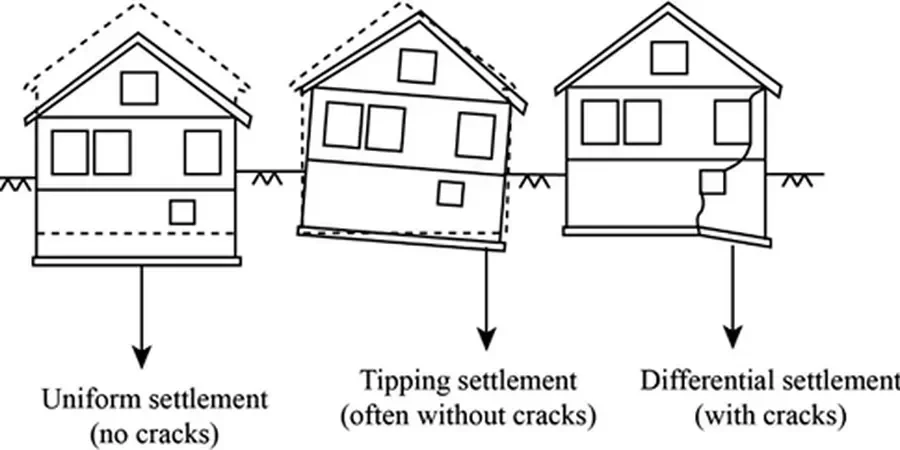
Blackburn's abrupt geological transitions between Pennine sandstone and soft alluvial clays make differential settlement the most common hidden risk in local foundation projects.
Technical details of the service in Blackburn
- Net allowable bearing pressure per unit
- Elastic modulus (E') from PLT and empirical correlations
- Consolidation settlement (Cc, Cr, mv) for fine-grained strata
- Differential ratio (Δ/L) against structural tolerance
Risks and considerations in Blackburn
The most common mistake we see on Blackburn sites is assuming uniform ground conditions from a single trial pit. One contractor on a housing development near Witton Country Park took one sample, designed identical strip footings, and ended up with 40 mm of differential settlement across a 15 m gable wall. The problem was a buried channel of soft organic clay that only showed up in the second borehole. A differential settlement analysis with multiple investigation points spaced no more than 10–15 m apart catches those hidden lenses. Skipping this step costs far more in remedial jacking and underpinning than the assessment itself.
Our services
We offer two complementary services that feed directly into the differential settlement analysis for Blackburn projects:
Bearing Capacity and Settlement Modelling
Finite element modelling of foundation settlement using SoilWorks or PLAXIS 2D, calibrated against SPT N-values and laboratory oedometer tests. We output differential movement contours for each structural bay.
Monitoring and Verification
Installation of settlement pins and precise levelling surveys (0.1 mm accuracy) during construction to verify predicted movements and trigger remedial action if thresholds are exceeded.
Questions and answers
What causes differential settlement in Blackburn specifically?
Blackburn's geology includes glacial till, alluvial clays, and made ground from old mill foundations. The abrupt lateral changes between stiff till and soft alluvium — especially near the Leeds and Liverpool Canal — create the settlement contrasts that damage structures.
How many boreholes do you need for a reliable analysis?
For a typical residential or light commercial development in Blackburn, we recommend a minimum of three boreholes spaced at 10–15 m intervals. On brownfield sites with variable fill, five or more may be necessary to map buried features like old mill ponds or infilled channels.
What is the typical cost range for a differential settlement study?
A full differential settlement analysis including site investigation, lab testing, and numerical modelling typically falls between £590 and £1,400 for a standard residential project in Blackburn. The final figure depends on the number of boreholes and the complexity of the ground model.
How long does the assessment take from start to finish?
Site work and lab testing usually take two to three weeks. The numerical modelling and reporting add another week. So you can expect a full differential settlement analysis report in three to four weeks from the date of instruction.