The difference between building on the sandstone ridge near Witton Country Park and the softer alluvial ground along the Blakewater valley is night and day for foundation design. In Blackburn, the geology shifts quickly from competent Pennine Millstone Grit to glacial till and river terrace deposits. A raft/mat foundation design in Blackburn must account for these lateral changes in bearing capacity and settlement potential. Before we finalise any mat geometry, we run a detailed ground investigation that picks up these transitions. That soil profile then drives the slab thickness, reinforcement layout and edge beam depth. We have seen too many projects where a uniform slab was specified across a site that actually had two distinct soil units underneath.
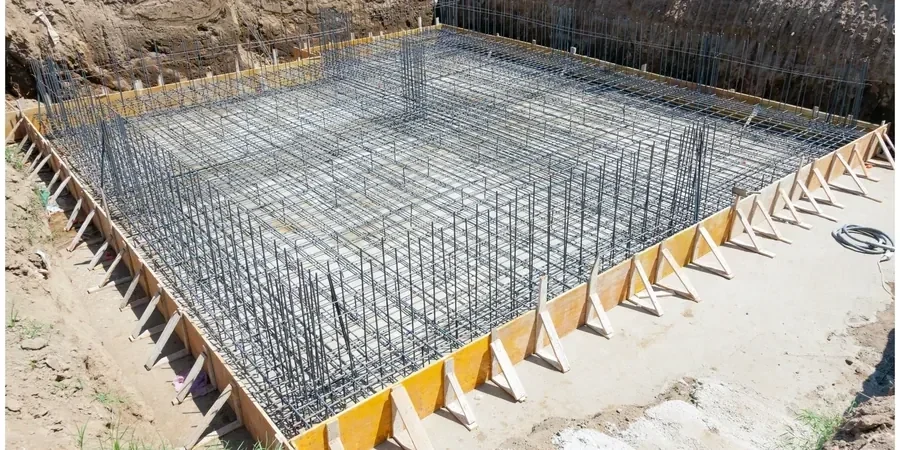
A single mat slab can mask variable ground if the investigation doesn't catch the changes. We check each zone separately.
Technical details of the service in Blackburn
- Subgrade reaction modulus (k-value) from plate loading or triaxial results
- Undrained shear strength of clay layers from triaxial testing on U100 samples
- Total and differential settlement estimates under service loads
- Water table depth – especially near the Leeds and Liverpool Canal corridor
Risks and considerations in Blackburn
A few years ago we worked on a residential block near Darwen Street where the structural engineer specified a 450 mm thick mat. The site looked uniform, but our trial pits revealed a buried channel of soft clay running diagonally across the plot. If that raft/mat foundation design in Blackburn had gone ahead without the investigation, the differential settlement would have cracked the internal partitions within two years. We revised the mat to include a stiffened rib under the clay zone and thickened the edge beam. That saved the client a significant retrofit cost. The lesson is clear: never assume uniform ground in Blackburn.
Our services
We offer three complementary services that support the raft/mat foundation design in Blackburn from field data to final parameter report.
Site Investigation & Soil Profiling
Trial pitting, window sampling and SPT in glacial till and mudstone. We log each stratum and collect undisturbed samples for lab testing.
Plate Load Testing
In-situ modulus testing on the bearing stratum to validate subgrade reaction values directly under the proposed mat footprint.
Settlement Analysis & Parameter Report
Elastic and consolidation settlement calculations using site-specific data. We issue a certified report with design parameters for the structural engineer.
Questions and answers
When is a raft/mat foundation better than strip footings in Blackburn?
A mat foundation is preferable when bearing capacity is low or variable, or when the structure has heavy column loads and tight settlement limits. In Blackburn, stiff clay and glacial till often give adequate capacity for strips, but a mat spreads the load across a larger area and reduces differential settlement risk.
What ground conditions in Blackburn most affect mat foundation design?
The main variable is the consistency of glacial till and the presence of soft alluvial pockets near the Blakewater valley. Buried channels of softer clay or silt can cause differential settlement. A thorough investigation with trial pits and SPT identifies these zones before the mat is designed.
How much does a raft/mat foundation design study cost in Blackburn?
A full geotechnical study for a mat foundation in Blackburn typically ranges between £920 and £3,810 depending on site size, number of boreholes or pits, and laboratory testing scope. This includes the site work, lab tests, analysis and a certified parameter report.
Do you follow Eurocode 7 for raft foundation design parameters?
Yes. All our parameter reports are produced in accordance with Eurocode 7 (EN 1997-1) and BS EN 1997-2. We calculate design values using partial factors from the UK National Annex and reference the relevant serviceability limits for mat foundations.