We drive a tracked sampling rig to your site in Blackburn. It handles soft ground and tight access. Our geotechnical engineer logs each stratum using visual description per BS 5930. We take undisturbed U100 samples and bulk disturbed bags. All samples are sealed and labelled on site. Back in the lab we run classification, strength, and consolidation tests. For deeper investigation we combine this with CPT soundings to get continuous soil profiles. The full soil mechanics study report includes bearing capacity and settlement calculations under Eurocode 7. We deliver results within 10 working days.
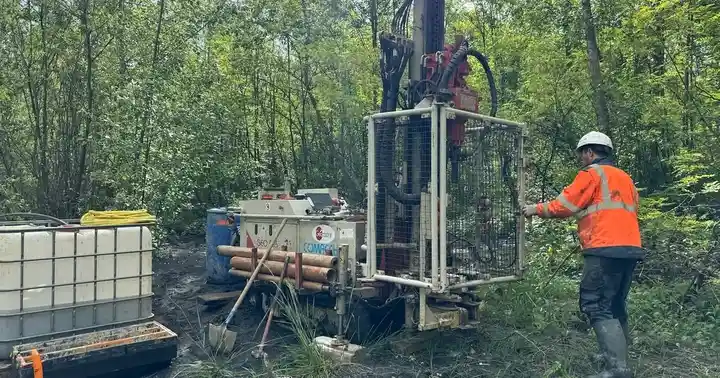
A solid soil mechanics study catches variable glacial till before foundation design begins, saving costly redesign later.
Technical details of the service in Blackburn
Procedure video
Risks and considerations in Blackburn
Eurocode 7 (BS EN 1997-1:2004) requires a ground investigation for all geotechnical design. In Blackburn, the main risk is natural variability within the glacial till. A thin sand layer can change bearing capacity by 50%. So can a clay seam. Without a proper soil mechanics study your foundation design becomes guesswork. Overdesign costs money. Underdesign risks failure. We have seen projects where a single trial pit missed a soft zone. A soil mechanics study with multiple boreholes and laboratory testing removes that risk. It gives the structural engineer reliable design parameters.
Our services
We offer two core laboratory-based services as part of a complete soil mechanics study for Blackburn projects.
Classification Testing
We determine moisture content, Atterberg limits, particle size distribution, and density. These index tests classify the soil and indicate its engineering behaviour. Results feed directly into foundation design and earthworks specification.
Strength and Consolidation Testing
We perform undrained triaxial (UU), consolidated drained (CD), and oedometer tests. These give shear strength parameters (c', phi') and consolidation characteristics (mv, cv). Essential for bearing capacity and settlement analysis under Eurocode 7.
Questions and answers
How many boreholes do I need for a soil mechanics study in Blackburn?
It depends on the site area and development type. For a single house plot we typically recommend two boreholes to 5-8 m depth. For larger developments we follow BS 5930 guidance: one borehole per 300-500 m2. Our team can advise after a site walkover.
What is the typical cost of a soil mechanics study in Blackburn?
The cost ranges from £2,320 to £4,220 depending on borehole depth, number of samples, and test scope. A basic study for a house plot is at the lower end. A full commercial investigation with triaxial and consolidation tests sits at the higher end. We provide a fixed quote after reviewing the site conditions.
How long does a soil mechanics study take from start to finish?
Fieldwork takes one to two days. Laboratory testing runs two to three weeks. Reporting adds three to five days. Total turnaround is usually three to four weeks. We can expedite for urgent projects.
What is the difference between a soil mechanics study and a site investigation?
A site investigation is the broader programme that includes desk study, walkover, trial pits, and boreholes. A soil mechanics study is the specific laboratory testing phase. We provide the soil mechanics study as part of a full investigation or as a standalone service if you already have field logs.