Blackburn’s position on the western edge of the Pennines means its topography includes steep valley sides and glacial till deposits that can mask deeper sand layers prone to seepage. These conditions demand a thorough slope stability analysis before any cut or fill operation. The analysis must account for pore-water pressures that fluctuate with Lancashire’s high annual rainfall, often exceeding 1,200 mm. We combine limit equilibrium and finite element approaches to evaluate factor of safety along potential failure surfaces, referencing Eurocode 7 (EN 1997-1:2004) for design. A reliable slope stability analysis in Blackburn requires site-specific soil profiles rather than assumptions based on regional geology alone. For shallow failures in weathered till, we recommend complementing the study with calicatas exploratorias to identify discontinuous clay lenses that alter drainage.
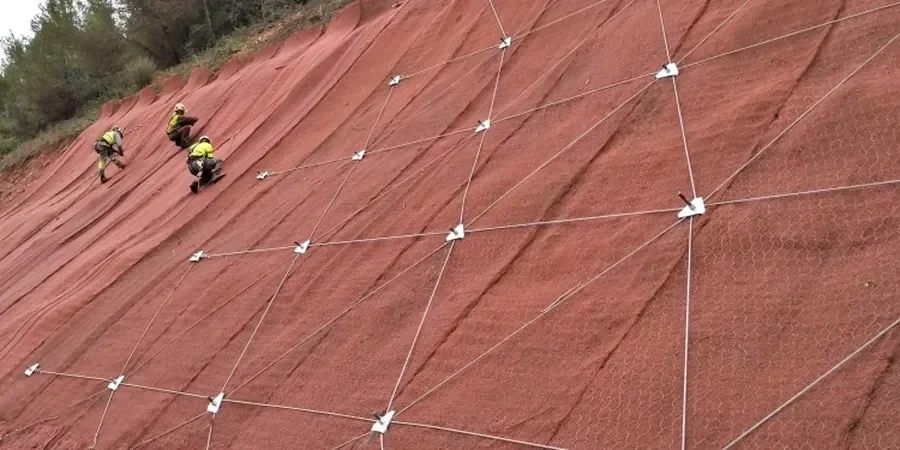
A slope stability analysis in Blackburn must integrate seasonal pore-pressure data with residual shear strengths from ring shear testing on pre-existing shear surfaces.
Technical details of the service in Blackburn
Risks and considerations in Blackburn
Blackburn sits on a geological mix of Millstone Grit and Lower Coal Measures, where interbedded shales and sandstones create anisotropic strength profiles. The presence of old mine workings beneath parts of the town introduces a risk of subsidence-related slope movements that are hard to detect without subsurface investigation. A slope stability analysis that ignores these man-made voids may overestimate the factor of safety by 20% or more. We always cross-reference the analysis with historical mining records from the Coal Authority database and include a sensitivity study on void collapse scenarios.
Our services
We deliver two complementary services for slope stability analysis in Blackburn, each tailored to project stage and risk profile.
Limit Equilibrium Analysis
Two-dimensional limit equilibrium analysis using SLIDE or Rocscience software. Includes circular and non-circular slip surface search, pore-pressure modeling with Ru or steady-state seepage, and probabilistic sensitivity analysis on shear strength parameters.
Finite Element Shear Strength Reduction
Two- and three-dimensional finite element analysis using PLAXIS or RS2. Captures progressive failure mechanisms, strain softening, and soil-structure interaction for slopes near existing foundations or retaining walls. Outputs include displacement vectors and stress contours.
Questions and answers
How much does a slope stability analysis in Blackburn cost?
A typical slope stability analysis for a single cross-section with two design scenarios costs between £940 and £1,680. For multiple sections with parametric studies and finite element modeling, the range extends to £3,740. Exact pricing depends on the number of sections, complexity of geology, and required reporting level.
What soil parameters are required for a slope stability analysis?
The analysis requires effective cohesion c' and friction angle phi' from drained or consolidated-undrained triaxial tests, unit weight, and pore-pressure conditions. For existing landslides, residual shear strength from ring shear testing is critical. Atterberg limits and grain size distribution help classify the material and estimate permeability.
How long does it take to complete the analysis and report?
A standard limit equilibrium analysis with a single failure mode and two load cases takes 5 to 10 working days from receipt of soil parameters. Finite element analyses require 10 to 15 working days. Urgent projects can be accelerated to 3 to 5 working days for an additional fee.