The soils beneath Blackburn differ considerably between the solid glacial till found around Corporation Park and the soft alluvial clays of the Darwen valley floor. This contrast means a single foundation solution rarely works across the borough. Our lime and cement stabilization service addresses both extremes: dry mixing for the high-plasticity clays of the western slopes and wet injection for the organic-rich silts near the River Blakewater. Before mobilising the pugmill we always run a full suite of Atterberg limits and Proctor compaction tests to establish the optimum binder dosage. In Blackburn this step is non-negotiable because moisture content varies more than 8% between adjacent plots. We also cross-reference with a clasificación de suelos to verify the dominant particle fractions before finalising the mix design.
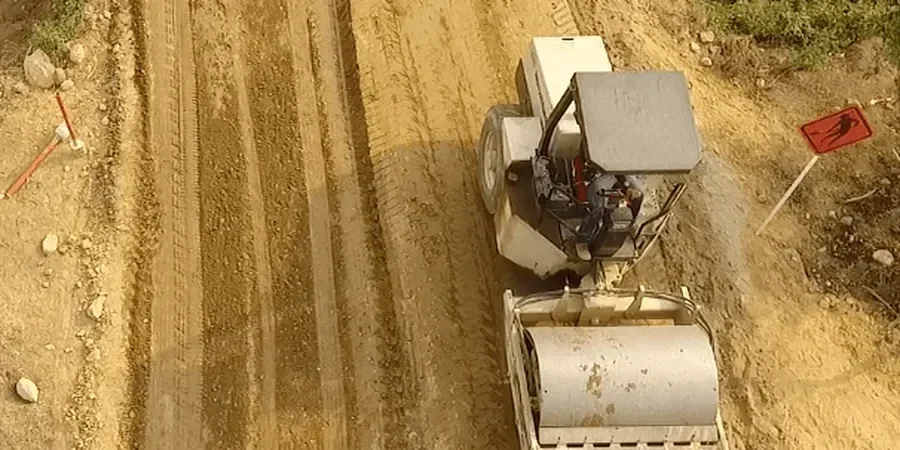
UCS values on Blackburn boulder clay typically rise from 0.2 MPa to 1.1 MPa after 28 days of lime stabilisation at 4% dosage.
Technical details of the service in Blackburn
- Determination of natural moisture content and density via core samples.
- Modified Proctor compaction to target 95% of maximum dry density.
- Unconfined compressive strength (UCS) tests at 7, 14 and 28 days.
- Californian Bearing Ratio (CBR) on cured specimens for pavement subgrade design.
Risks and considerations in Blackburn
The humid Pennine climate of Blackburn keeps subsoils near saturation for most of the year. When we treat clay with lime, the exothermic hydration reaction needs a moisture window between 18% and 28%; outside that range the pozzolanic reaction stalls and the soil never gains strength. During autumn months we often work with pre-dried stockpiles to control water content. Another recurring issue is the presence of thin peat lenses within the glacial till, particularly near the Leeds and Liverpool Canal corridor. These organic layers resist cement hydration and require higher binder dosages or pre-treatment with a flash set inhibitor. Skipping a full chemical characterisation here can lead to soft spots that manifest months after compaction.
Our services
We deliver two complementary stabilisation services in Blackburn, each tailored to the project phase and ground conditions encountered.
Laboratory Mix Design for Lime Stabilisation
We perform full-scale mix design studies on bulk samples from the site. The process includes Eades & Grim pH test to determine initial lime consumption, unconfined compressive strength (UCS) at 7, 14 and 28 days, and durability assessment through wet-dry cycling. The output is a certified dosage recommendation that satisfies the project's bearing capacity and long-term swelling limits.
Field Verification & Quality Control of Cement Stabilisation
Once the stabilisation layer is placed, we carry out in-situ density tests using the sand replacement method and retrieve undisturbed cores for laboratory UCS. We also monitor the curing temperature profile because cement hydration in Blackburn's cool climate can delay strength gain. A final CBR test on the treated subgrade confirms compliance with the design specification before the pavement layer is laid.
Questions and answers
How much does lime or cement stabilisation cost per m³ in Blackburn?
The typical cost in Blackburn ranges between £750 and £1.730 per cubic metre for a full service including mix design, field application supervision and quality control testing. The final price depends on binder dosage, volume of soil treated, and access constraints. We always provide a detailed quotation after reviewing the site investigation data.
What is the minimum curing time before loading a stabilised layer?
For lime stabilisation we recommend a minimum of 14 days of moist curing before any traffic loading. Cement-stabilised layers can be opened to light construction traffic after 7 days if ambient temperatures stay above 8°C. We validate the curing period with UCS results from site-cured cylinders to ensure the specified strength has been achieved.
Can stabilisation be applied to Blackburn's peat layers?
Peat requires a different approach because its high organic content inhibits cement hydration directly. We typically pre-treat peat with a flash set additive or raise the cement dosage to 8-10% combined with a calcium chloride accelerator. Alternatively, we recommend removing the peat lens and replacing it with a stabilised granular fill. A full chemical characterisation of the organic matter is essential before any binder selection.