Blackburn's position on the western edge of the Pennines means much of the city is underlain by Millstone Grit and Coal Measures strata, where sandstone and shale sequences create highly variable permeability conditions. Field permeability testing, specifically the Lefranc and Lugeon methods, is the most reliable approach to measure hydraulic conductivity in these fractured rock masses and granular drift deposits. For any basement excavation or deep foundation scheme in Blackburn, quantifying groundwater flow is essential — it directly affects dewatering design, slope stability, and the choice of temporary works. The tests are carried out in accordance with BS 5930:2015 and the guidance within Eurocode 7 (BS EN 1997-2:2007), ensuring the results are defensible for both design and regulatory approval. Before committing to a full dewatering strategy, a targeted field permeability test provides the site-specific data that desk studies and borehole logs alone cannot deliver.
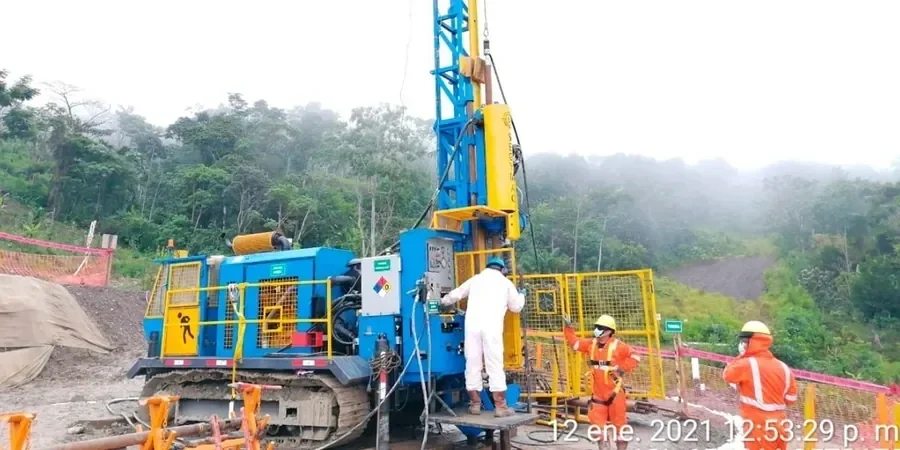
A single Lugeon test in the Millstone Grit can reveal permeability differences of two orders of magnitude within a 3-metre section — crucial for dewatering volume estimates.
Technical details of the service in Blackburn
Procedure video
Risks and considerations in Blackburn
In Blackburn, the contrast between the high-permeability sandstones of the western suburbs and the low-permeability glacial clays of the town centre creates a classic risk pattern. A development on the former Blackburn Rovers training ground at Brockhall, for instance, would encounter sandstone with K values exceeding 1×10⁻⁴ m/s, demanding significant dewatering, whereas a site near the Leeds-Liverpool Canal may sit on laminated clay with K below 1×10⁻⁸ m/s, where water ingress is negligible but excavation stability becomes the concern. A single field permeability test per lithological unit is the minimum; ignoring vertical anisotropy in the interbedded sequence can lead to under-designed cutoff walls or over-priced pumping contracts.
Our services
We deliver two principal field permeability testing services in Blackburn, each tailored to the local geology and project requirements.
Lefranc Permeability Testing
Constant-head and falling-head tests performed in NX or HX boreholes for soils and weak rock. Suitable for clays, silts, sands, and glacial tills. Results are presented as K values with a graphical analysis of flow behaviour, ideal for dewatering design and drainage layer specification.
Lugeon Packer Testing
Multi-stage pressure injection tests in competent sandstone and mudstone aquifers. Five pressure steps (0-3-6-3-0 bar) provide a full hydraulic conductivity profile and identify joint-controlled flow. The data supports groundwater modelling, grouting specifications, and slope stability assessments in Blackburn's Pennine foothills.
Questions and answers
What is the difference between a Lefranc and a Lugeon test?
The Lefranc test is used in soils and weak rock where a single packer isolates a test zone and water is injected at constant or falling head. The Lugeon test is designed for fractured rock; it applies five incremental pressure stages to induce laminar or turbulent flow, revealing joint-controlled permeability and hydraulic conductivity under realistic stress conditions. In Blackburn, Lugeon tests are preferred for the Millstone Grit sandstone, while Lefranc tests suit the overlying glacial clays.
How much does a field permeability test cost in Blackburn?
The typical cost for a single Lefranc or Lugeon test in Blackburn ranges from £530 to £930, depending on borehole depth, test section length, and access constraints. The price includes mobilisation, packer installation, water supply, on-site testing, and a full laboratory report with K values and flow analysis. For multiple test sections in the same borehole, the per-test cost reduces.
When is a field permeability test required for a Blackburn development?
A field permeability test is required whenever groundwater control is critical: basement excavations below the water table, infiltration basins for SuDS, earthworks in variable glacial tills, or foundation designs in fractured sandstone aquifers. Blackburn's geology of interbedded mudstone and sandstone means desk studies alone cannot predict K values with confidence – In-Situ is the only way to obtain design parameters that satisfy BS 5930 and the local building control authority.