Blackburn sits atop a mix of glacial till, alluvial deposits from the River Blakewater, and Carboniferous Millstone Grit. The water table fluctuates seasonally, often sitting 2–4 metres below ground in the town centre. These conditions create unpredictable void networks and seepage paths that require careful grouting design. Our approach starts with a full site investigation, including permeability testing in the field to map flow paths and seismic refraction surveys to locate fractures in the bedrock before we specify any injection programme.
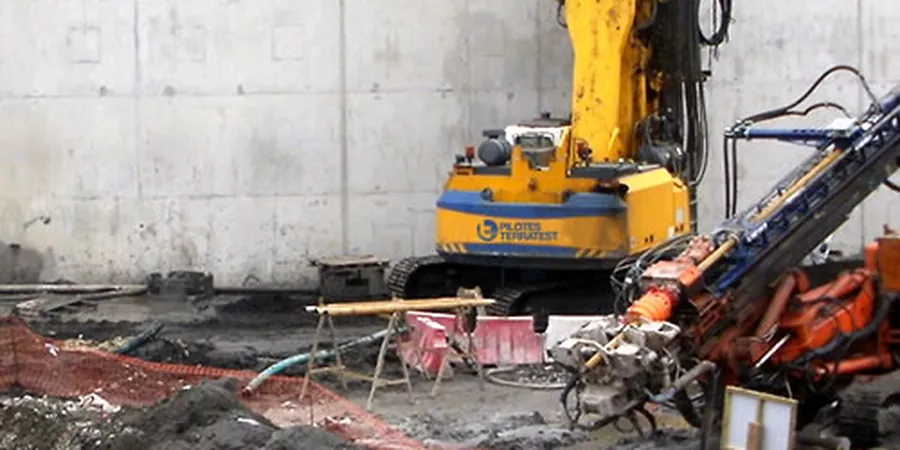
One grout mix never fits Blackburn's layered till and fractured gritstone — we design each injection around the actual soil profile.
Technical details of the service in Blackburn
Procedure video
Risks and considerations in Blackburn
We use a twin-piston injection unit with digital flow meters and pressure transducers. It is mounted on a tracked carrier to reach tight access sites around Blackburn's terraced streets. The operator monitors real-time data on a tablet — if pressure exceeds the fracture limit of the soil, the pump shuts off automatically. This prevents hydrofracture damage to adjacent services. For chemical grouts we wear full PPE and run continuous air monitoring. The whole setup is calibrated before each shift and checked against the design parameters from the site investigation.
Our services
We offer four core grouting design services tailored to Blackburn's ground conditions. Each is backed by UKAS-accredited laboratory testing and field quality control.
Permeation Grouting Design
For sandy gravel layers in the glacial till, we design low-pressure permeation grouting to fill pore spaces without displacing the soil. We specify suspension or chemical grouts based on particle size analysis and injection test results.
Fracture Grouting (Rock Injection)
Targeting the Millstone Grit fractures beneath central Blackburn. We design high-mobility cement grouts to seal open joints and reduce water inflow. Injection is staged with packers to control spread and avoid surface heave.
Compaction Grouting for Void Fill
Where abandoned mine workings or solution cavities exist under old industrial sites, we design stiff, low-slump grout injected under high pressure to compact surrounding soil and fill voids. Typically used under existing foundations.
Chemical Grouting for Water Cut-Off
For fine sands and silts where cement grout cannot penetrate, we design acrylic or polyurethane chemical grouts with controlled set times. Common in Blackburn's basement excavations and sewer tunnel headings where groundwater control is critical.
Questions and answers
How long does a grouting design take for a typical Blackburn project?
For a standard residential or light commercial site, the design phase takes 5 to 10 working days after receiving the site investigation data. Complex fractured-rock or void-fill projects may require an additional week for injection test trials.
What is the typical cost range for grouting design in Blackburn?
The cost for grouting design in Blackburn is between £930 and £2,970 depending on site complexity, number of injection zones, and required QA testing. A full quote is provided after reviewing the ground investigation report.
Can grouting fix settlement issues under an existing house in Blackburn?
Yes, compaction grouting can lift and stabilise settled foundations by injecting stiff grout bulbs beneath the footing. We first assess the cause of settlement through a plate load test and soil profiling to ensure the grout targets the correct bearing layer.
Do you need a full site investigation before grouting design?
We strongly recommend it. A borehole or trial pit gives us the soil profile, permeability, and fracture data needed to select grout type, pressure, and spacing. Without it, the design is speculative and may not achieve the intended seal.
How do you verify that the grouting has worked?
We run post-injection verification using core sampling, permeability testing, and sometimes cross-hole tomography. A reduction in water inflow or an increase in soil strength confirms the treatment. All results are documented in a completion report.