A four-storey extension to a Victorian mill on Heys Lane was sinking into the soft alluvial clays that underlie much of Blackburn town centre. The original strip footings could not carry the new load without excessive settlement. We designed a jet grouting treatment plan that created a grid of solicrete columns beneath the existing foundation, transferring loads to the more competent glacial till at 8 m depth. Before finalising the geometry, we cross-checked the column layout with a plate load test on a trial column to verify the target unconfined compressive strength of 4 MPa. The design accounted for the presence of old mine workings recorded in the British Geological Survey archive for the Blackburn area, ensuring no cavities intersected the treatment zone.
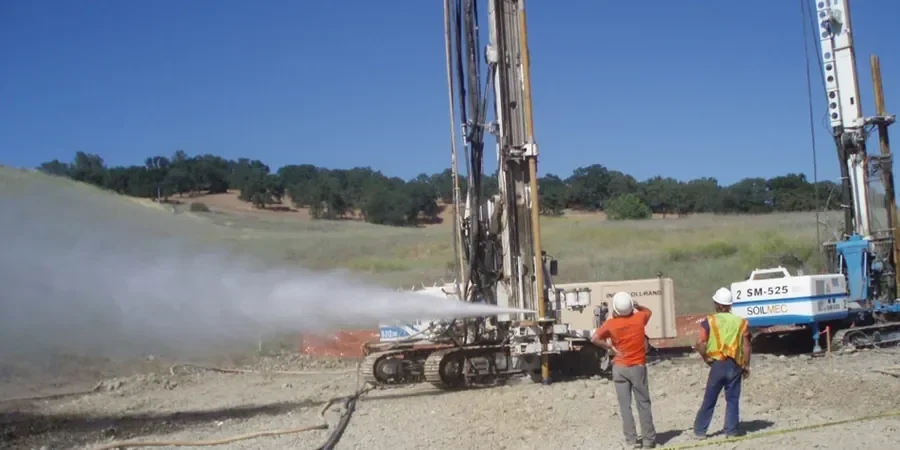
Jet grouting in Blackburn requires careful accounting for shallow mine workings and variable alluvial thickness typical of the Ribble Valley.
Technical details of the service in Blackburn
Risks and considerations in Blackburn
A common mistake in Blackburn is assuming jet grouting works the same in all soils. The alluvial clays here contain thin sand lenses that can cause preferential grout flow, leaving gaps in the column network. Another error is designing columns without verifying the actual diameter achieved in the local ground conditions. We have seen cases where a contractor specified 1.5 m columns but the trial exhumation showed only 1.1 m because the rig pressure was too low for the stiff clay at depth. This leads to untreated soil between columns and a foundation that still settles. Our design process always includes a trial column exhumation and a verification of the as-built column geometry before proceeding with the full treatment grid.
Our services
We offer two complementary jet grouting services tailored to Blackburn ground conditions.
Design-only jet grouting scheme
We produce a full jet grouting design including column layout, geometry, grout mix specification, and QA testing protocol. The deliverable includes a verification plan with trial column requirements and acceptance criteria, compliant with BS EN 12716. Suitable for projects where the client already has a preferred contractor and only needs the engineering design.
Design-and-verify jet grouting package
We design the treatment scheme and then supervise the trial column execution, interpret the exhumation results, and adjust the design parameters accordingly. This package includes on-site monitoring of pressure, flow rate, and lift speed during production, plus core sampling and UCS testing at 7 and 28 days. Ideal for complex sites in Blackburn where ground variability is high.
Questions and answers
How deep can jet grouting columns reach in Blackburn ground conditions?
In Blackburn the treatment depth is typically limited to 15–20 m by the rig capacity and the presence of stiff glacial till. Below that depth the soil becomes too dense for effective erosion with standard mono-fluid equipment. For deeper zones we would recommend alternative methods such as compensation grouting or deep soil mixing.
What is the typical cost range for a jet grouting design in Blackburn?
The cost for a jet grouting design scheme in Blackburn ranges from £1,320 to £5,140 depending on the number of columns, the need for trial column exhumation, and the complexity of the ground model. This covers the design report, specification, and QA plan. Execution costs are separate and vary with contractor rates and mobilisation.
How do you verify the column diameter after installation?
We require a trial column exhumation at every jet grouting project in Blackburn. The column is excavated to a depth of at least 2 m so the actual diameter can be measured directly. We also take cores from the trial column for UCS testing. If the measured diameter is less than the design value, we adjust the grout parameters (pressure, lift rate, or water/cement ratio) before proceeding with production columns.
Can jet grouting be used under existing buildings in Blackburn?
Yes, jet grouting is commonly used for underpinning existing structures in Blackburn, especially Victorian mills and terraced houses on shallow foundations. The rig can be positioned in a basement or at ground level with a low headroom configuration. The main risk is grout return through cracks in the existing floor slab, so we always design a grout return management plan and monitor slab heave with precise levelling during injection.