In Blackburn, the combination of Coal Measures mudstones, glacial till, and made ground from industrial history creates a variable ground profile that standard penetration tests alone cannot fully characterise. The Menard pressuremeter test (PMT) measures the soil's stress-strain response directly in the borehole, delivering the Menard modulus (EM) and limit pressure (pL). This test is particularly valuable where stiff clays or weak rock are expected at depth, such as along the valley sides of the River Blakewater. For projects involving deep excavations or piled foundations, a calicatas exploratorias programme may precede the PMT to confirm stratigraphy before deploying the probe.
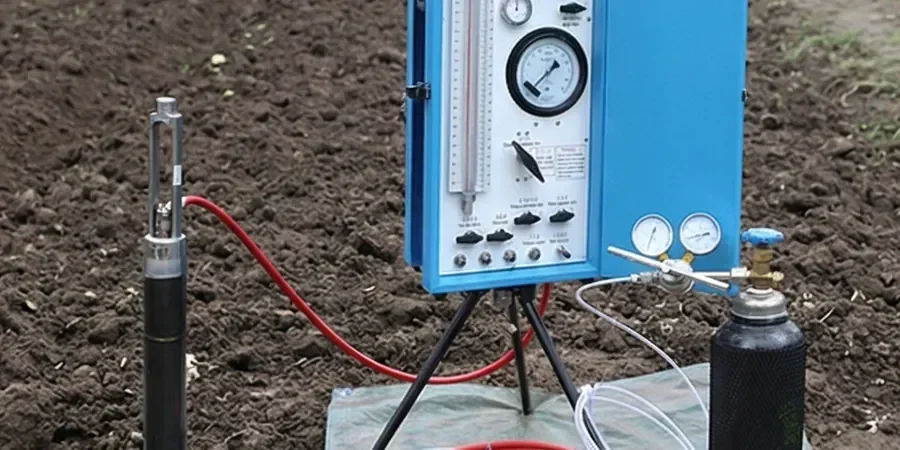
The Menard pressuremeter test delivers in situ modulus and limit pressure data that SPT alone cannot provide for stiff tills and mudstones typical of Blackburn.
Technical details of the service in Blackburn
Risks and considerations in Blackburn
Blackburn expanded rapidly during the Industrial Revolution, with textile mills built on river terraces and colliery spoil used as fill. These old fills are notoriously variable, and unconsolidated spoil can mask competent strata below. Without a pressuremeter test, the design may overestimate settlement in the fill while missing the high stiffness of the underlying till or mudstone. This mismatch leads to either over-conservative foundations or, worse, differential settlement that cracks building fabric. Pairing the PMT with a ensayo de placa de carga at formation level provides a direct comparison of in situ stiffness at the surface and at depth.
Our services
We offer a full range of pressuremeter testing services tailored to Blackburn's ground conditions. Each test is supervised by a chartered geotechnical engineer and reported with full calibration certificates.
Onshore Menard PMT (Standard Borehole)
Conventional pre-bored pressuremeter testing in rotary-cored or augered boreholes from 1 m to 50 m depth. Suitable for stiff clays, glacial till, and weak mudstone. Includes real-time data logging and interpretation within 5 working days.
Self-Boring Pressuremeter (SBP) for Soft Ground
For soft alluvial clays or peat deposits found in the Ribble Valley floodplain, the self-boring technique minimises disturbance and provides the most reliable modulus values. Recommended when settlement tolerances are tight.
Pressuremeter Testing in Rock
Modified high-pressure probe (up to 20 MPa) for weathered Coal Measures mudstone and sandstone. Used to assess bearing capacity of rock-socketed piles and tunnel face stability in Blackburn's bedrock.
Pressuremeter Test Interpretation & Design Reports
Detailed analysis of pL, EM, and pf values correlated with laboratory index tests. Reports include Menard bearing capacity and settlement calculations in accordance with Eurocode 7 and BS 5930.
Questions and answers
What does the Menard pressuremeter test measure in Blackburn's ground?
The PMT measures the in situ stress-strain response of soil or weak rock. It outputs the limit pressure (pL) and the Menard modulus (EM). These parameters are used to calculate bearing capacity and settlement for foundations, tunnels, and retaining walls in glacial till and mudstone sequences typical of Blackburn.
How deep can the pressuremeter test reach in Blackburn?
Standard Menard probes can test from 1 m down to 50 m depth. For deeper investigations, such as for high-rise foundations on the valley slopes, we use a heavy-duty G-Am probe capable of reaching 60 m with a pre-drilled borehole. Depths are confirmed by trial pits beforehand.
What is the difference between PMT and SPT for design in Blackburn?
SPT provides an index of resistance (N-value) but does not measure stiffness or limit stress directly. PMT gives the complete stress-strain curve, yielding EM and pL, which are required for advanced settlement analysis in stiff tills and weathered rock. In Blackburn's mixed ground, PMT reduces design conservatism by up to 30% compared to SPT-only approaches.
How much does the Menard pressuremeter test cost in Blackburn?
The typical cost for a single Menard pressuremeter test in Blackburn ranges between £760 and £980, depending on depth, access, and number of tests per borehole. Volume discounts apply for campaigns of six or more tests. The price includes mobilisation, one technician, data processing, and a factual report.
Do I need a pressuremeter test for a small housing development?
For low-rise houses on shallow foundations in competent glacial till, a PMT is not always necessary. However, if the site is on made ground, old colliery spoil, or near the River Blakewater floodplain, a single PMT at the deepest point can confirm the stiffness and avoid overdesign. For multi-storey buildings or piled foundations, the PMT is strongly recommended.