Blackburn sits on a varied geological sequence that includes glacial till, alluvial deposits, and weathered Millstone Grit. The elevation ranges from about 120 m to 270 m above sea level, which creates significant variation in subgrade conditions across the borough. For any highway or pavement scheme, understanding the stiffness and drainage of these materials is critical. We have assessed subgrades on the A666 corridor and on housing estate access roads near the M65, where the transition from stiff till to soft alluvium caused differential settlement issues. Our road geotechnics approach starts with a desk study of BGS records, followed by targeted trial pits and dynamic cone penetrometer testing to map the soil profile. Before you design the pavement structure, you need reliable CBR values — and that is where our laboratory and In-Situ comes in. Combining plate load tests with laboratory triaxial data gives us a solid basis for pavement thickness design under DMRB or local authority standards.
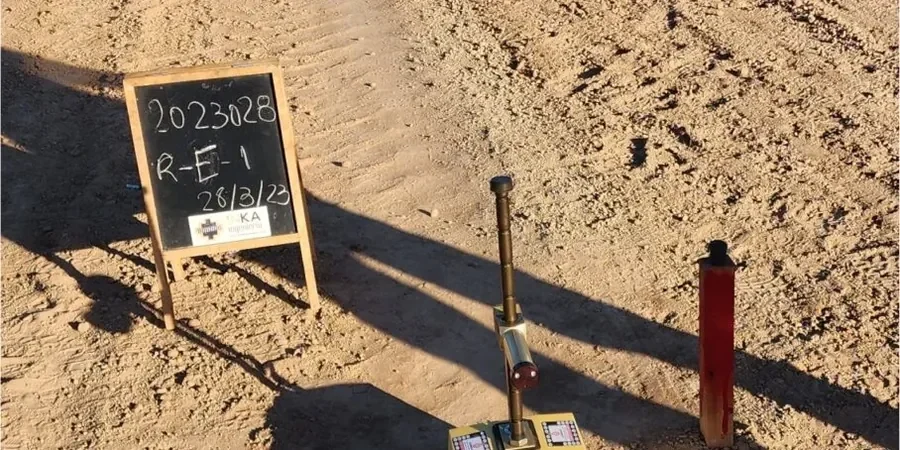
Subgrade CBR values in Blackburn’s alluvial zones can fall below 2%, demanding either thick granular capping or a stabilisation treatment before pavement construction.
Technical details of the service in Blackburn
- Dynamic Cone Penetrometer (DCP) surveys at 50 m intervals to map CBR variability along the alignment
- Laboratory soaked CBR tests on recomposed samples at Proctor density
- California Bearing Ratio correlation with undrained shear strength from field vane tests
- Particle size distribution and Atterberg limits to assess frost susceptibility and plasticity
Risks and considerations in Blackburn
A common mistake we see on Blackburn road schemes is assuming the subgrade is uniform because the topsoil looks similar. One contractor on a residential estate near Shadsworth laid 300 mm of Type 1 sub-base directly on what they thought was good till — but a trial pit revealed a 1.2 m thick layer of soft alluvial clay beneath the first 0.3 m. Within two years the road showed longitudinal cracking and differential settlement. The cost of retrofitting a capping layer and geogrid far exceeded the price of a proper subgrade investigation upfront. Our road geotechnics assessment catches those hidden layers before the pavement design is finalised.
Our services
We provide a full suite of road geotechnics services tailored to Blackburn’s ground conditions. Every investigation is carried out under UKAS accreditation (ISO 17025) and reported in accordance with Eurocode 7 and DMRB standards.
Subgrade Investigation & CBR Testing
DCP surveys, trial pits, and laboratory soaked CBR tests on undisturbed and remoulded samples. We correlate results with soil classification to assign design CBR values for each pavement layer.
Pavement Foundation Design Support
We analyse subgrade stiffness, frost susceptibility, and drainage to recommend capping thickness, sub-base type, and whether stabilisation with lime or cement is needed. All designs follow CD 225 and local authority specifications.
Improvement Assessment
Where weak alluvial soils are present (CBR < 3%), we evaluate options such as lime/cement stabilisation, geogrid reinforcement, or removal and replacement. Our stabilisation with lime and cement service includes mix design and strength verification.
Earthworks Quality Control
On-site density testing (sand replacement and nuclear gauge), moisture condition value (MCV) tests, and proof rolling. We verify that compacted fills achieve the specified stiffness before pavement layers are placed.
Questions and answers
What CBR value is typically assumed for Blackburn’s glacial till subgrade?
For the competent glacial till found across much of Blackburn, soaked CBR values typically range from 5% to 8% at Proctor density. However, the till can vary in gravel content and plasticity, so a site-specific DCP survey at 50 m intervals is essential to confirm the design value rather than relying on published averages.
How does road geotechnics differ from a standard site investigation for a building foundation?
Road geotechnics focuses on the subgrade’s stiffness and drainage over a linear alignment, not just bearing capacity at a single point. We measure CBR, plasticity, and frost susceptibility at regular intervals, and we design the pavement foundation layers (capping, sub-base, base) to spread traffic loads. A building foundation investigation would instead concentrate on settlement and bearing resistance at footings or piles.
What is the cost range for a pavement subgrade investigation in Blackburn?
For a typical residential estate or minor highway scheme in Blackburn, the cost falls between £720 and £2,860 depending on the length of alignment, number of trial pits, and laboratory testing scope. This includes DCP surveys, CBR tests, soil classification, and a design report. Larger trunk road schemes with multiple phases will be quoted individually.
Do I need a ground investigation if the road is built on existing hardstanding or old pavement?
Yes. Existing hardstanding may mask weak subgrades or contaminated ground. We have seen cases in Blackburn where old tarmac and hardcore hid soft alluvial clay just 400 mm below the surface. A few trial pits and DCP tests through the existing pavement reveal the true subgrade condition and prevent premature failure of the new surface.
Coverage in Blackburn
Watch how it works
This service complements our laboratory testing work for a complete project analysis.