Blackburn sits on the western edge of the Pennines, where the bedrock sequence shifts from Millstone Grit in the north to Coal Measures clays and shales under the town centre. Soil profiles here are highly variable: stiff glacial till over weathered mudstone in the higher ground, alternating with soft alluvial deposits along the River Blakewater and its tributaries. For any retaining wall design in Blackburn, the critical first step is understanding the perched water tables that form after heavy rainfall. We have measured groundwater at depths of only 0.8 m in the lower-lying industrial estates near the M65 corridor. That water pressure alone can double the load on a wall if not accounted for in the drainage design. Our team combines borehole data with plate load tests to calibrate stiffness parameters for each stratum before finalising the wall geometry.
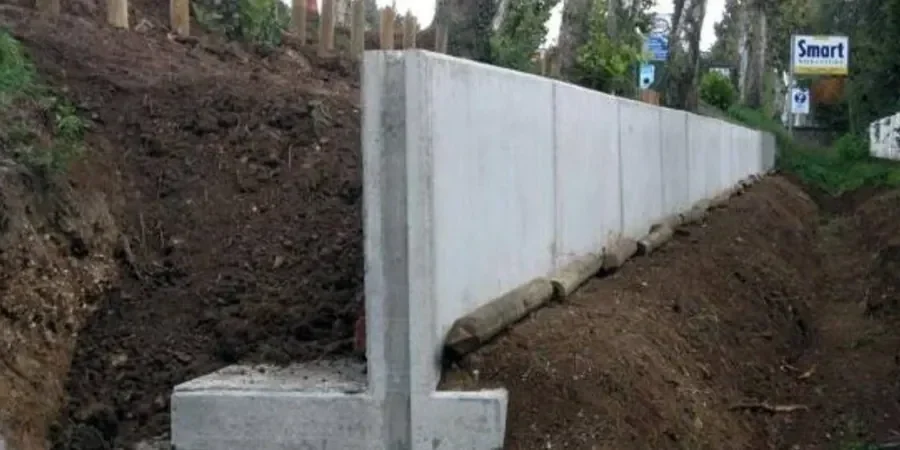
Perched water tables at 0.8 m depth in Blackburn’s low-lying areas can double the design load on a retaining wall unless drainage is correctly modelled.
Technical details of the service in Blackburn
Procedure video
Risks and considerations in Blackburn
A 4 m high basement wall we designed near Blackburn Cathedral faced a common problem: the contractor excavated a trench and left it open for three days during a wet spell. The till softened, the water table rose, and a section of the temporary face collapsed into the excavation. That incident delayed the programme by six weeks and cost £12 000 in additional shoring and re-compaction. In Blackburn, a retaining wall design must include a solid temporary works scheme — either soldier piles with lagging or a soil-nailed slope — because the Pennine clays lose strength rapidly once exposed. We now specify a minimum 200 mm drainage layer behind every permanent wall, connected to a perforated pipe at the toe, to prevent the hydrostatic build-up that caused that collapse.
Our services
We deliver two core retaining wall services in Blackburn, each tailored to the local ground conditions described above.
Gravity & Cantilever Wall Design
For sites with competent till or weathered rock within 3 m of the surface, we design reinforced-concrete cantilever walls and mass gravity walls. The service includes bearing capacity checks, sliding and overturning verification, reinforcement detailing per BS EN 1992, and a full drainage scheme with weep holes and filter geotextile. We provide stamped calculations and construction drawings for Building Control approval.
MSE & Anchored Wall Design
Where soft ground, space constraints, or heights above 5 m rule out cantilever options, we design mechanically stabilised earth (MSE) walls with steel or polyester strips, and anchored walls with permanent ground anchors. The service covers internal stability analysis, pull-out capacity verification, corrosion protection design, and long-term creep assessment for the Blackburn alluvial clays.
Questions and answers
What is the typical cost range for a retaining wall design in Blackburn?
For a standard residential project (wall height 1.5–3.0 m), design fees including site investigation and structural calculations fall between £880 and £3 090. Commercial or tall walls requiring anchored systems or complex drainage can exceed this range. The final fee depends on wall length, ground conditions, and the level of site investigation needed.
Do I need a geotechnical investigation before the wall design starts?
Yes. Without boreholes or trial pits, we cannot determine the soil strength, groundwater level, or presence of soft layers that govern the wall type and dimensions. In Blackburn, where the geology changes from till to alluvium within 200 m, a desk study alone is insufficient. We recommend at least two boreholes to 1.5 times the wall height, complemented by laboratory tests on undisturbed samples.
How do you handle groundwater behind the wall in Blackburn?
We design a drainage blanket of clean gravel at least 200 mm thick, wrapped in a non-woven geotextile, connected to a perforated pipe at the wall toe. A hydrostatic pressure analysis using the worst-case water table (often 0.8 m deep in Blackburn’s low areas) ensures the wall is sized for the full saturated condition. We also specify a weep hole pattern at 1.5 m centres to relieve any residual pressure.