Eurocode 8 (BS EN 1998-1:2004) sets the framework for site-specific seismic response analysis in the UK. Blackburn's location on the Ribble Valley's edge means variable superficial deposits over solid Carboniferous bedrock. This contrast creates potential for ground motion amplification at certain frequencies. Our laboratory runs 1D equivalent linear and nonlinear wave propagation models to derive response spectra. We also evaluate strain-dependent shear modulus and damping curves from resonant column tests. Before modeling, we correlate field data using MASW surveys to constrain the VS30 profile. The output directly informs structural engineers on design spectra adjustments.
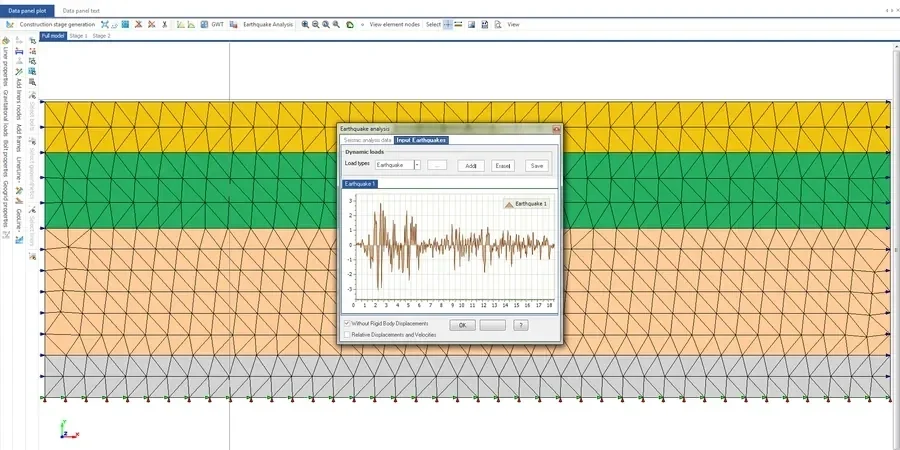
A soft peat layer at depth can shift seismic energy toward longer periods, potentially aligning with the natural period of a three to five storey building.
Technical details of the service in Blackburn
- Field geophysics (MASW, ReMi) to measure shear wave velocity profiles down to 30 m.
- Laboratory cyclic triaxial and resonant column tests on undisturbed samples to obtain G/Gmax and damping curves.
Procedure video
Risks and considerations in Blackburn
Blackburn's wet climate saturates the upper soil layers for long periods. Saturated loose sands and silty deposits in the Darwen Valley can lose shear strength under cyclic loading. This raises the risk of cyclic softening or even lateral spreading in a moderate seismic event. Our site response analysis accounts for excess pore pressure generation using a coupled effective stress approach. We flag zones where the factor of safety against liquefaction falls below 1.0. Results are delivered in a clear geotechnical interpretative report with site-specific design spectra.
Our services
We offer two complementary levels of site response analysis tailored to Blackburn's ground conditions.
1D Equivalent Linear Analysis
Uses vs30/" data-interlink="1">shear wave velocity profiles from MASW or downhole seismic surveys. Input motions from UK seismic hazard maps. Output includes acceleration response spectra, amplification factors, and Fourier amplitude ratios. Suitable for most building and infrastructure projects in Blackburn.
Nonlinear Effective Stress Analysis
Captures pore pressure build‑up and stiffness degradation during shaking. Requires cyclic triaxial or simple shear test data. Used for critical structures like hospitals, schools, or tall buildings where performance‑based design is required.
Questions and answers
What is the typical cost for a site response analysis in Blackburn?
A standard 1D equivalent linear study with field geophysics and laboratory testing typically ranges from £1,200 to £3,500 depending on depth, number of boreholes, and project complexity. Nonlinear effective stress analyses cost more due to advanced cyclic testing and longer processing time.
How deep do we need to measure shear wave velocity for site response?
Eurocode 8 requires characterisation to at least 30 m depth for VS30 classification. In Blackburn, we often extend to 40 m to reach stiff bedrock. MASW or ReMi surveys provide continuous velocity profiles down to that depth.
What is the difference between 1D equivalent linear and nonlinear analysis?
Equivalent linear uses a strain‑compatible modulus and damping iteratively; it is faster and works for low to moderate shaking. Nonlinear analysis integrates the full stress‑strain path in the time domain, capturing pore pressure effects and modulus degradation more accurately for strong shaking.
Does Blackburn have a high seismic hazard?
The UK is a low‑to‑moderate seismicity region. Blackburn's peak ground acceleration on rock is around 0.06g to 0.12g for a 475‑year return period. However, local soil amplification can increase surface PGA by a factor of 1.5 to 3.0, which is why site‑specific analysis is recommended.