Blackburn sits on a mix of glacial till and alluvial deposits along the River Darwen, with ground conditions that often challenge conventional foundations. The city’s elevation around 120 m above sea level means seasonal groundwater fluctuations are common, particularly in low-lying areas near the river corridor. When we encounter soft clays or loose sands beneath planned structures, a properly executed stone column design restores bearing capacity and reduces settlement. Before specifying the column pattern, we first correlate soil behaviour with results from a plate load test to calibrate modulus values. This approach ensures the design matches actual ground stiffness rather than relying solely on empirical charts.
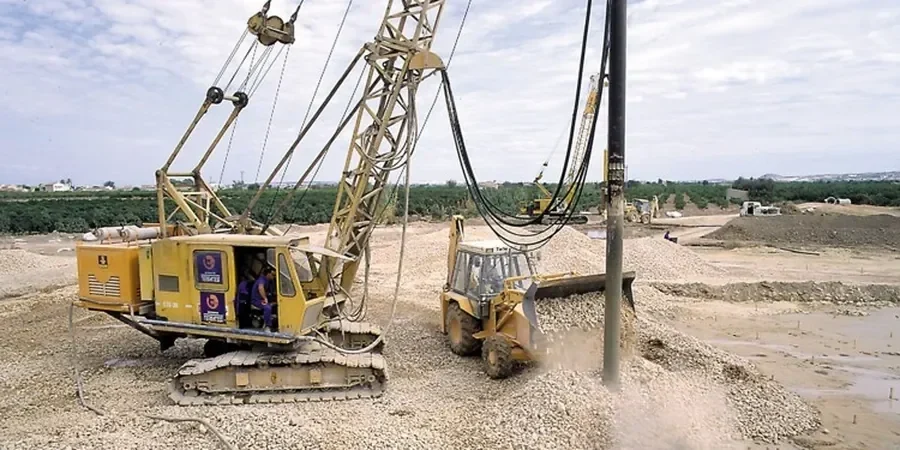
Stone column design in Blackburn demands a thorough assessment of alluvial softness, groundwater depth, and lateral confinement to prevent column bulging under load.
Technical details of the service in Blackburn
- Undrained shear strength (su) via lab triaxial or field vane.
- Lateral confinement coefficient from CPTu dissipation tests.
- Column diameter achievable with the available vibratory probe.
- Stress concentration ratio between column and intervening soil.
Risks and considerations in Blackburn
In Blackburn, many engineers underestimate the effect of shallow groundwater on stone column performance. When the water table sits within 1 m of the surface, the vibratory probe displaces water upward, creating temporary pore pressure that can destabilise the column walls before the stone lock is achieved. We mitigate this by sequencing columns in a staggered pattern and using a coarser aggregate gradation to improve drainage during installation. Another risk arises when peat lenses remain undetected — organic layers can compress under the vibratory energy, causing the column to lose contact with the bearing stratum. A targeted CPT before design catches these weak inclusions early.
Our services
We provide two complementary stone column services tailored to Blackburn’s ground conditions. Each is backed by full in-situ and laboratory testing, with all work carried out under ISO 9001 quality management.
Vibro-replacement stone columns
A bottom-feed vibratory probe penetrates soft alluvium, then aggregate is fed as the probe withdraws. The resulting column densifies the surrounding soil and provides a stiff load-transfer element. We design the grid pattern and aggregate size based on the site-specific shear strength profile, typically achieving settlement reductions of 50–70 %.
Rammed stone columns (dry method)
For sites with limited headroom or sensitive nearby structures, we use a dry, top-feed method that displaces soil laterally without water jets. This technique works well in Blackburn’s stiffer glacial till layers where vibro-probes struggle to penetrate cobbles. The columns are rammed in lifts, and we verify density with a dynamic cone penetrometer after each stage.
Questions and answers
How much does stone column design cost in Blackburn?
For a typical residential or light commercial project in Blackburn, the design and installation cost ranges between £1,290 and £3,780 depending on column depth, spacing, and aggregate haulage distance. This includes site investigation review, column layout drawings, and a settlement verification report. Larger industrial plots with deeper treatment fall at the upper end of that range.
What soil conditions in Blackburn require stone columns instead of piles?
Stone columns work best where the upper 4–8 m consist of soft alluvial clays or loose sands underlain by a competent bearing stratum. In Blackburn’s Darwen floodplain, we often find that piles would require end-bearing depths beyond 15 m, while stone columns can improve the shallow soft layer to support spread footings at a fraction of the cost. The decision hinges on the undrained shear strength and the presence of obstructions like cobbles.
How long does a stone column design study typically take?
A standard stone column design for a Blackburn site is completed within 5 to 10 working days after receiving the ground investigation data. This includes settlement calculations, column layout optimisation, and a construction specification. If additional in-situ tests such as CPTu or vane shear are required, add 3 to 5 days for field work and interpretation.