Blackburn sits on a mix of glacial till and alluvial deposits from the River Blakewater, with shallow groundwater in many central areas. That combination makes soil behaviour under load unpredictable without proper testing. A triaxial test gives you the key parameters — cohesion and friction angle — needed for foundation design, slope stability checks, or pavement layers. We run both UU and CU tests under BS 1377-8:1990, and can consolidate specimens to match in-situ conditions before shearing. For projects on soft ground near the Leeds-Liverpool Canal, this data is essential. Before we start any triaxial work, we often recommend a muestreo inalterado campaign to ensure sample quality, and cross-check results with corte directo when dealing with stiff clays.
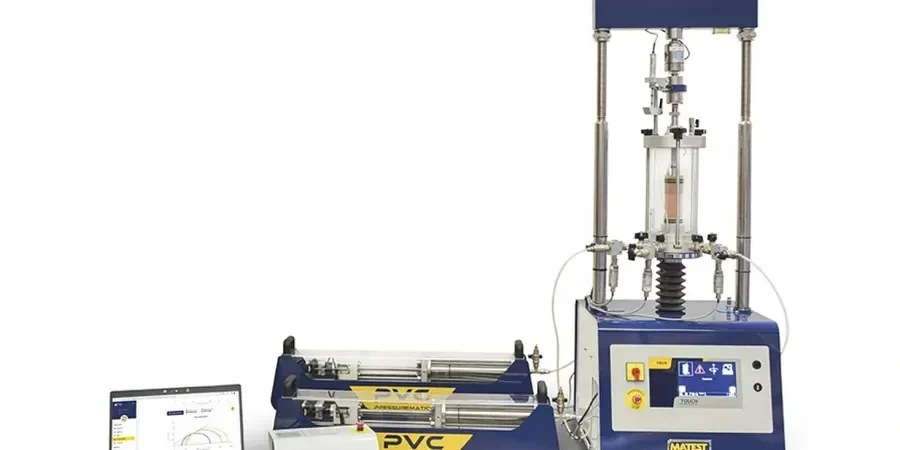
A triaxial test on glacial till from Blackburn typically shows friction angles between 28 and 35 degrees, with cohesion ranging from 5 to 15 kPa.
Technical details of the service in Blackburn
Risks and considerations in Blackburn
The glacial till in Blackburn can be heavily overconsolidated, which means it has high peak strength but can lose strength rapidly after failure — a brittle behaviour that catches many designers out. If your design assumes the peak strength from a quick UU test, you might miss post-peak softening. That's a real risk for slope cuts near the railway lines or deep excavations in the town centre. A properly conducted CU triaxial test with pore pressure measurement captures this drop in strength. We also run cyclic triaxial tests when seismic loading is a concern, though Blackburn is in low seismicity zone. Ignoring the soil's true undrained strength can lead to heave, basal failure, or excessive settlement. We've seen it happen on small housing developments where budgets were tight and testing was skipped.
Our services
We offer a full range of triaxial testing options to match your project stage and budget.
Consolidated Undrained Triaxial (CU) with Pore Pressure Measurement
Our most requested test for Blackburn projects. Saturation under back pressure, isotropic consolidation at the design effective stress, then shearing at 0.1 mm/min. You get effective stress parameters c' and φ', plus undrained strength cu. Ideal for foundation design and slope stability analysis. Results delivered within 10 working days.
Unconsolidated Undrained Triaxial (UU) — Rapid Screening
Quick assessment of undrained shear strength for preliminary design or low-risk works. No saturation or consolidation — we shear the specimen immediately after applying confining pressure. Typical turnaround 5 working days. Best used alongside CU tests for a complete picture. Suitable for embankment stability checks in Blackburn's alluvial areas.
Questions and answers
What is the difference between a UU and a CU triaxial test?
A UU (unconsolidated undrained) test measures the undrained strength of a soil specimen without allowing consolidation under the confining pressure — it simulates short-term loading in saturated clays. A CU (consolidated undrained) test consolidates the specimen to the expected effective stress first, then shears it undrained while measuring pore pressure. CU gives you both total and effective stress parameters, and is more suitable for long-term design scenarios in Blackburn's overconsolidated tills.
How much does a triaxial test cost in Blackburn?
Our typical price range for a full CU triaxial test with pore pressure measurement is between £1,570 and £2,220 per specimen, including report and engineer review. UU tests are lower, around £890 to £1,200. Volume discounts apply for multiple specimens from the same project. Prices may vary depending on sample condition, required confining pressure, and urgency of turnaround.
What sample quality is needed for a reliable triaxial test?
You need undisturbed samples from thin-wall tube samplers or block samples. Disturbed or partially dried samples produce unreliable results — we will reject them. Ideally, specimens are 70 mm or 100 mm diameter to minimise disturbance effects. For Blackburn's glacial till, we recommend triple-tube core barrels for borehole sampling. Samples must be sealed, kept moist, and transported upright to the lab within 48 hours.